
See a real UNDR report.
This is what comes back after you send us a scoop. Take the tour below, or open the whole thing as a PDF and read it end to end.
Built from a real sample we ran in Redding, California. A few of the finds are illustrative, so every section of the report has something in it.
No expert required. Ten minutes, your own mailbox, nobody on your property.
See your ground's stats. How it drains, how it leans, what grows well in it.
Unearth value. Gold, silver, platinum and the rare earths.
Private and confidential. We never sell your name or address.
Learn your land, and how to care for it. What it's made of, how it behaves, what it responds to.
A report you'll want to share. Plain English, your land's type, real comparisons.
The tour
Twelve pieces of a real report
Every number below came back from a real UNDR report. Most of these panels are rebuilt so the type stays sharp on a phone; the maps, the charts and the periodic table are screenshots of the report itself.
01
The first screen
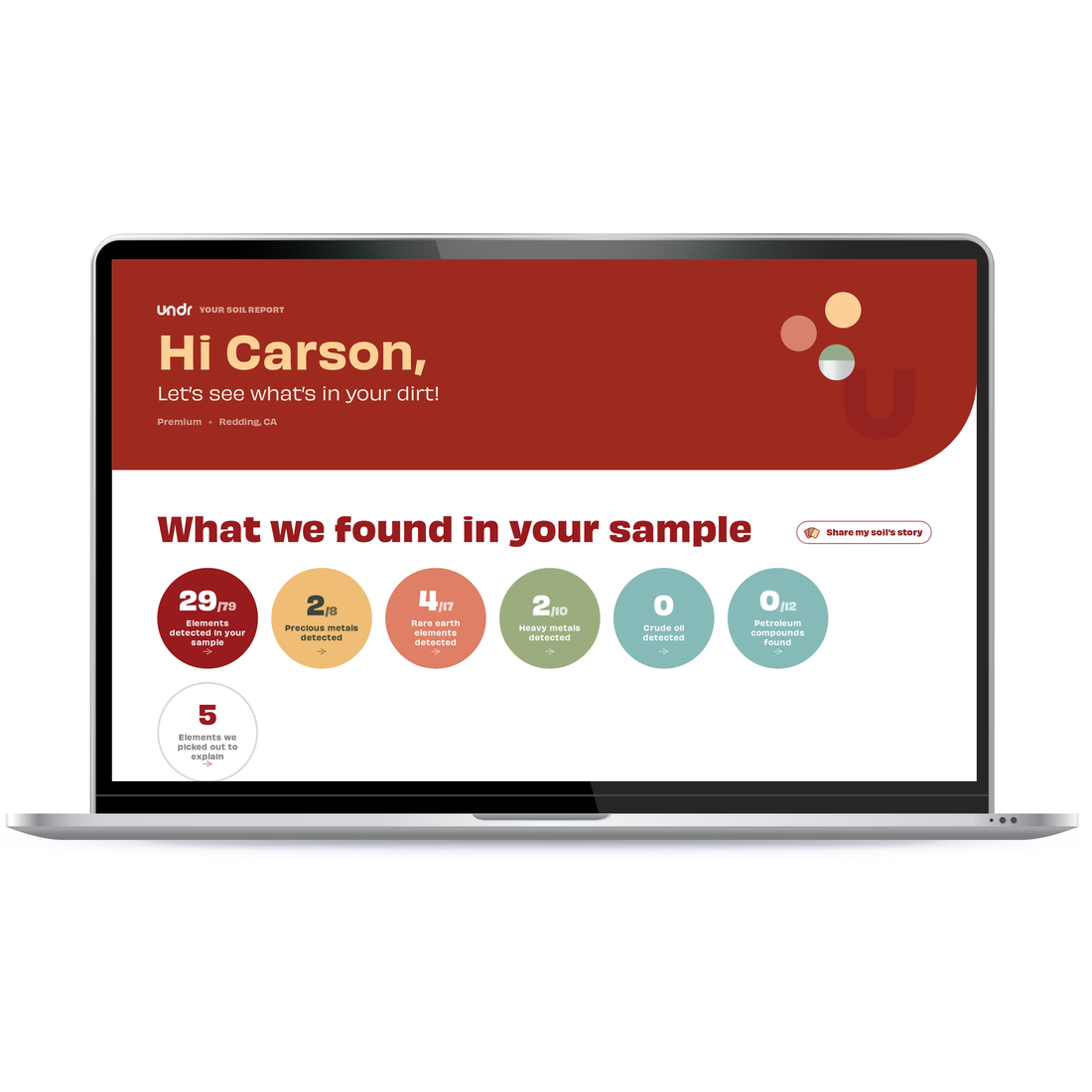
Your name, your town, and the whole sample counted up before you scroll anywhere.
undr · your soil report
Hi Carson,
Let's see what's in your dirt!
What we found in your sample
This is the Premium report, which screens the widest list. Treasure Plus and Health & Safety Plus each carry their own set of these.
02
Your dirt gets a name
A soil type read off the chemistry, what it usually sits on, and the places around the world that share it.
If we had to give your sample a name
Volcanic
Serpentine typeWhat this means ▾
WorldUnited States
In the report those two tabs open a world map and a U.S. map you can move around.
03
Where soil like yours turns up
Forty-six regions across every continent share this soil type. The report maps all of them.

Tap to open it full size.
04
And the survey sites nearest you
The same card switches to the United States, with every public survey site plotted and your own sample marked.

05
Places your dirt keeps company with
For a handful of readings, the report finds somewhere on earth whose ground sits in the same range, and tells you what that place is like.
Your sample's vanadium level is in the range of
Scottish Highlands
Hills rolling toward cold lochs, peat bogs famous for producing rich, smoky single malt Scotch.
Vanadium, 178 ppm in your sampleYour sample's iron level is in the range of
Australia's Pilbara region
Sun-scorched plains blazing red-orange, ancient rock formations jutting from the earth, the ground so iron-rich it's been mined for decades.
Iron, 42,520 ppm in your sample06
Six things about your ground
Read off the chemistry, set against typical U.S. soil, and each one comes with a test you can run in your own kitchen.
Acidity
AcidicNeutralAlkaline
Likely acidic
Calcium came in well under typical, which usually goes with acidic ground. Blueberries, azaleas and potatoes tend to be happy here. Most vegetables and lawn grass like it a little sweeter, and a bag of garden lime is the common fix.
Try this at home: vinegar on a spoonful›Texture
SandyLoamClay
Clay leaning
Aluminum came in at 2.3× typical against silicon, which points to clay. Clay is heavy going with a shovel, it puddles after rain and it can crack when it bakes, and the upside is that it holds onto water and nutrients once plants are established.
Try this at home: roll a ribbon›Drainage
Drains fastMixedHolds water
Holds water
Clay chemistry holds water long after a storm, which suits thirsty plants and does not suit anything that likes dry feet.
Try this at home: the jar test, then dig after a storm›Salt
LowTypicalSalty
Low
Sodium came in under typical. Low salt ground drains well and is easy on most plants.
Try this at home: look for a white crust›Nutrient holding power
Lets nutrients wash throughHolds nutrients
High
Clay and magnesium together hold onto whatever goes into the ground, so compost lasts a long time here and so does anything else that gets added.
Try this at home: the mulch check›Rain-washed
LightlyWashedHeavily
Heavily washed
Iron came in at 2.6× typical with aluminum alongside: red or orange ground where rain has stripped out nearly everything soluble. Acid lovers thrive in it, and vegetables want lime and fertilizer.
Try this at home: the streak test›07
Precious metals, all eight
Every one of the eight gets a bar, including the six that came back at zero. Silver and gold showed up in this sample, at trace levels.

Precious metals are screened on the Treasure Plus and Premium kits. Traces are traces, and the report says so.
08
Rare earths, drawn to scale
Seventeen rare earth elements are screened. Four came back in this sample, and each circle is sized by how much.

Rare earths are screened on the Treasure Plus and Premium kits.
09
The readings worth a second look
Five elements get a card of their own, with the number, the range it usually falls in, and why it stood out. This is the silver card from that sample.
What Stood Out
In Your Sample
Five elements read high against soil nationally but are ordinary for your area. We picked the 5 that landed furthest from a typical reading, the ones that make your dirt your dirt.
Below averageTypical rangeAbove average
Silver came in above the typical background of under 1 ppm, which hardly any sample does, so this sample holds more silver than most, and that is a low-risk reading, since silver isn't a concern below 50 ppm. Readings of 10 to 20 ppm have historically gone with ground near precious-metal rock.
More about this reading ▾Your reading 62 ppm Margin of error ± 6.9 ppm
How much
33× above the typical rangeTypical soil runs 0.13 to 1.9 ppmHow common
RareThe most distinctive reading in your sampleWorth understanding
The interesting question is where the silver came from, so curious owners sample more spots and look at what the rock underneath is, and a local assayer or geologist is who people talk to about going further. The rare skin condition tied to silver comes from industrial exposure rather than from soil.10
Ten heavy metals, screened
Each one sits on its own scale, with the reading marked where it landed. Two showed up in this sample and eight did not.
Toxic Heavy
Metals
We screened for all ten, and found two in this sample. The other eight did not show up. Chromium came in above the usual range, which is ordinary for soil near you, and it is explained below.
Lead is on the list as well. Heavy metals are screened on the Health & Safety Plus and Premium kits.
11
What a scoop is actually made of
The whole sample drawn as blocks, sized by how much of it each element is. The report magnifies the small end twice so the traces are visible too.

Silicon is the biggest block here at 22.7 percent, then aluminum at 7.9.
12
Twenty-nine of the ninety-two
Every lit square was found in this sample, and the brighter the square, the more of it there was. Oxygen and silicon are the brightest here.

Tap any lit square in the real report to read about that element.
13
And one part we keep back
The report closes with a resources section. We blur it on every sample we hand out. It arrives readable in yours.
Additional Resources
Where to go next with what your sample turned up.
Readable in your own reportSame treatment as the sample PDFs, so what you see here is what a sample shows everywhere.
Read one end to end.
Three kits, three reports. Open whichever one matches what you want to know. They open in a new tab, and nothing is asked of you first.
Treasure Hunting
From $9950+ elements, gold and silver included. Plus adds crude oil and the 17 rare earth elements.
Results in 3-5 business days after your sample reaches the lab. Open the Report Get the Treasure Hunting Kit →Health & Safety
From $14950+ elements, ten heavy metals included. Plus adds twelve petroleum compounds.
Results in 3-5 business days after your sample reaches the lab. Open the Report Get the Health & Safety Kit →UNDR Premium
$29990+ elements and substances. Everything both kits screen for, in one report.
Expedited results, as fast as 1-2 business days after your sample reaches the lab. Open the Report Get UNDR Premium →If your report doesn't tell you something about your sample you didn't already know, email us and we'll refund it.
Free shipping both ways·30-day returns on unopened kits·Our own U.S. lab·Curiosity Guarantee on every kit
Now go find out what's in yours.
Ten minutes with a shovel, your own mailbox, and a report like the one you just read.
Free shipping both ways.


